What market making actually is
A market maker does not bet on the price going up or down. It posts a buy order slightly below the market and a sell order slightly above it, and waits for other traders to trade against them. Buy low, sell high, over and over, in small steps. The gap between the two prices is what you earn.
Two things eat into it. The venue charges a fee on every fill, and sometimes the price keeps moving after your order is hit, so the position you are left holding is worth a little less than you paid. Add both together and you get the only number that matters here: cost per million dollars traded, which we write as CPM. Lower is better.
On Ondo the fees alone are 80 CPM for a maker, so that is the floor. Everything above it is the price of execution, and that is the part a good mode keeps small. In our own live sessions Argent runs in the 90s.
Gold and the S&P 500
A market maker needs a book with real depth on both sides, otherwise every order moves the price against itself. We measured every Ondo market and these two are the deepest: at the best price gold holds roughly $5–13k and the S&P 500 holds $23–30k. Your order of a few hundred dollars is invisible there, which is exactly what you want.
- Gold (XAU)
Trades around the clock, seven days a week. The spread is usually one tick. This is the market Argent was calibrated on.
- S&P 500 (US500)
Deepest book of the two during the trading week. On weekends the index itself is closed: the book thins out, the spread widens and fills become rare. Nothing is broken then, there is simply nobody to trade with.
Other Ondo markets cost noticeably more per fill, which is why Argent is offered on these two and nowhere else.
One signature, no API keys
Open the connect page and pick Ondo. You sign one message in your wallet and Vesper mints a trade-only key: it can place and cancel orders and it cannot move your funds. There is nothing to copy, paste or store.

Ondo carries the Argent badge with both market icons: gold and the S&P 500.
Ondo access is invite-only for now: your Ondo account has to be created with our referral code. If the connect step tells you that, create the account first and come back. The Ondo guide walks through it.
Argent is already selected
Go to Settings → Strategy. Argent sits first in the list and is picked by default for new accounts. If you have used Vesper before and chose another mode yourself, your choice is kept — select Argent to switch.
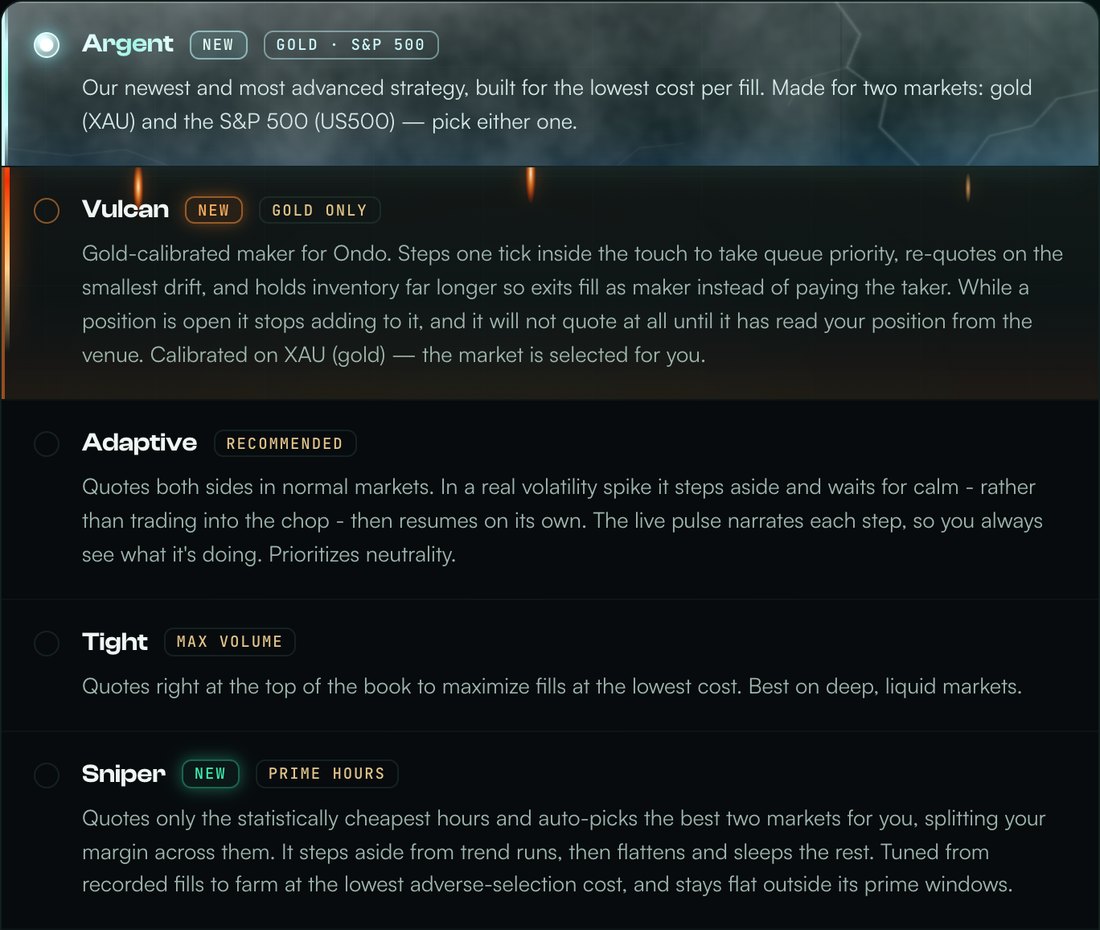
The strategy list. Argent is the frozen card at the top.
Gold or the S&P 500
In Argent the market list is narrowed to the two markets the mode is built for. Pick one. You can switch later: stop the session, choose the other market, start again.
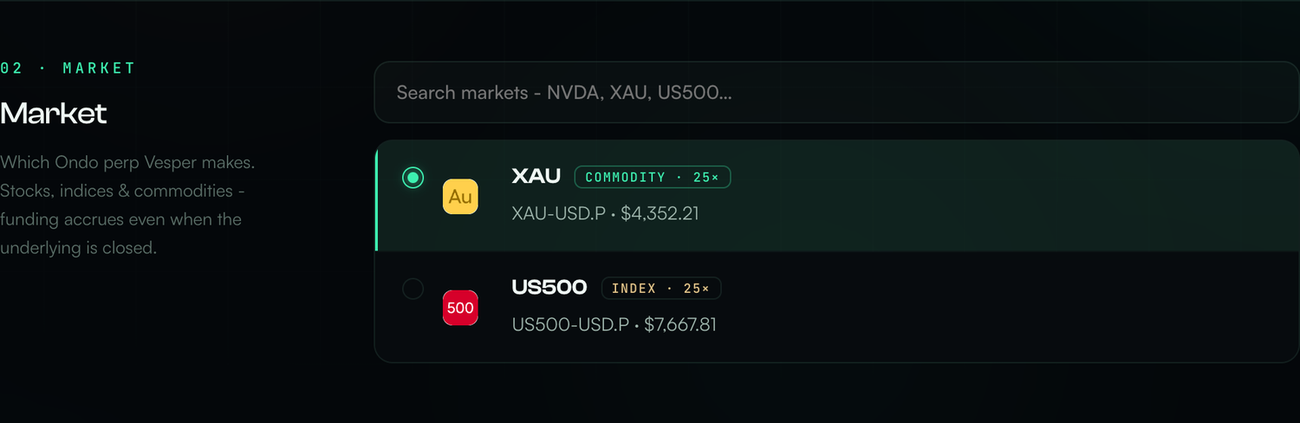
Two markets, live prices from the venue.
How much it puts to work
You set two things: how much collateral to deploy and the leverage. Together they give the buying power, and Vesper sizes each order and the inventory ceiling from it automatically.
One order can never exceed a safety ceiling tied to your own deposit: deposit × leverage ÷ 8, and never more than $400. The cabinet prints the exact number under the slider, so if your setting is above it you can see so at once. If you want a bigger order, raise the leverage — adding collateral alone will not lift the ceiling.
Then press Start and sign once more. The first minute or two the mode reads the book and stays flat on purpose. A session that looks idle in its first minutes is warming up, not broken.

Running: the badge names the mode and what it is doing right now.
What the dashboard tells you
The pulse card narrates every step in words. Making markets means both orders are in the book. Working off inventory means it holds a position and is quoting only the side that reduces it. Holding for calm means the market moved too fast and it stepped aside on purpose.
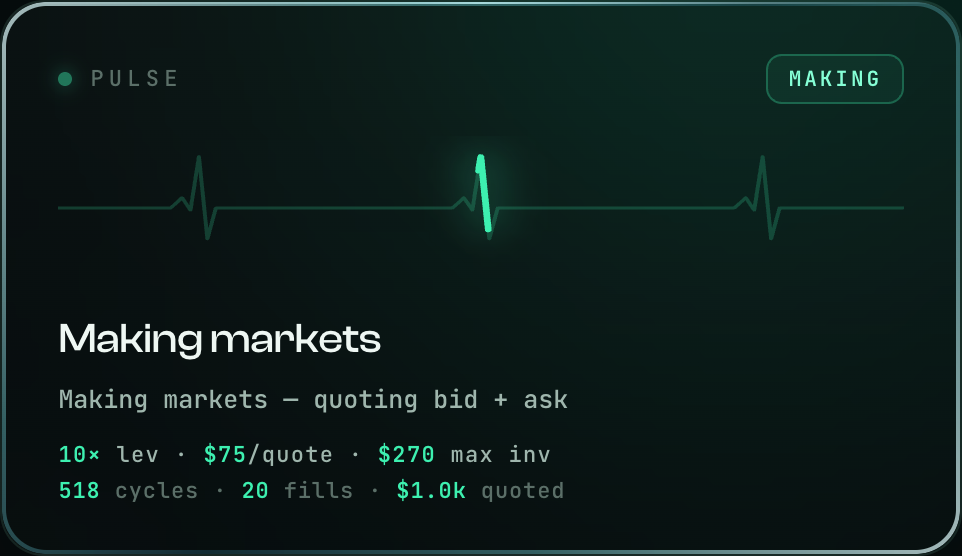
Your settings and the live count of cycles, fills and quoted volume.

CPM is the one to watch. It combines fees and execution into a single price per million traded, and it is shown net of the venue's maker rebate.
CPM needs volume before it means anything. On the first few fills it swings wildly; after about a thousand dollars of turnover it settles down.
Three changes, each measured
Argent is our gold-calibrated maker with three refinements. Each was tested on recorded books on its own before all three ran together, and then the whole mode ran head to head against the previous one on the same account, at the same time.
- Follows the price sooner
It re-places a quote when the market has moved half as far as before, so its orders sit where the market actually is.
- Exits two ticks inside
The closing order is placed inside the spread instead of at the edge, so positions close sooner and still as a maker, without paying the taker fee.
- Exits the exact position
The closing order is sized to what is left, so it can never flip you into the opposite position by accident.
- Result
8–9 CPM cheaper than the previous mode on gold at the same turnover, over a 48-hour head-to-head run on one account.
Bigger orders barely cost more
A fair question before you raise the size: does a bigger order get a worse price? We measured it on recorded gold books over six paired 24-hour windows, with the queue modelled honestly.
| Order size | CPM | vs $25 | Turnover |
|---|---|---|---|
| $25 | 127.7 | base | 100% |
| $45 | 127.8 | +0.0 | 180% |
| $90 | 128.1 | +0.2 | 357% |
| $140 | 128.3 | +0.5 | 553% |
| $280 | 128.6 | +0.8 | 1097% |
Eleven times the turnover costs under one CPM — because at these sizes you are still a rounding error against the depth of the book. This is why the ceiling is set by your margin and not by the price of size.
No stop-loss, no time limit
Argent ships without a drawdown stop and without a run timer, and that is a deliberate choice rather than a missing feature.
A market maker holds inventory for a while, and while it holds, the unrealised result swings up and down. A small stop cuts the session off mid-swing. We watched exactly that happen: a session with a one-dollar stop ran for a full day and 1 746 fills, then halted on a $1.06 swing — working perfectly, stopped by its own guard.
- What protects you
The inventory ceiling, which caps how large a position can grow, and the volatility guard, which steps aside when the market runs.
- You are in control
Press Pause at any time. The mode closes the position and stops, and the dashboard confirms it is flat with no orders left behind.
What Argent cannot do
Move your funds. The key it signs places and cancels orders only. There is no withdrawal path, and you can revoke it at any time.
Promise a return. It earns on turnover and loses on inventory that moves against it. Individual sessions end down.
Trade other markets. Gold and the S&P 500 only. For anything else the cabinet offers the general-purpose modes.